
With over 75 per cent indigenous content, the frigate is among the most self-reliant frontline warships built in India.

Defence Minister Rajnath Singh will commission Mahendragiri, the sixth Project 17A indigenous stealth frigate, into the Indian Navy's Eastern Fleet in Visakhapatnam on Saturday, marking another milestone in India's journey towards defence self-reliance and indigenous warship construction.

India has commissioned its new indigenously-built nuclear-powered ballistic missile submarine INS Aridaman into service, further strengthening the naval component of its nuclear triad. Defence Minister Rajnath Singh also highlighted the Indian Navy's role in securing maritime trade routes.

INS Udaygiri and INS Himagiri marks the first occasion when two frontline surface combatants constructed at two different shipyards were commissioned simultaneously.

India's three major listed shipyards - Mazagon Dock Shipbuilders Limited (MDL), Garden Reach Shipbuilders & Engineers Limited (GRSEL), and Cochin Shipyard Limited (CSL) - are poised for substantial growth, driven by a robust order pipeline from the Indian Navy and diversification into commercial and export markets.

Indian shipyards Mazagon Dock Shipbuilders Limited (MDL), Garden Reach Shipbuilders & Engineers Limited (GRSEL), and Cochin Shipyard Limited (CSL) are set for substantial growth, driven by a significant pipeline of Indian Navy orders and diversification into commercial and export markets. The Navy's share in defence spending is approximately 21 per cent, ensuring robust order visibility for these domestic players.

The Indian Navy's Republic Day tableau will showcase indigenous platforms like INS Vikrant and a stitched ship from the 5th century CE, highlighting the theme of a 'Strong Navy for a Strong Nation'.

The Defence Acquisition Council (DAC) has recently approved procurement proposals worth Rs 79,000 crore across three services and it has cleared AoN (Acceptance of Necessity) of Rs 3.3 trillion in financial year 2026 (FY26).

This is the sixth of seven ships built under 'Project 17 Alpha' for the Navy. The first five ships of the project were launched between 2019 and 2022.

Still, there remains a worrying shortfall of frigates, which are the navy's workhorses. 'We need to have at least 24 frigates,' says a senior admiral. 'Currently we are 10 short.'

Vice President Jagdeep Dhankhar, whose wife Sudesh launched the warship, was the chief guest at the ceremony.

This is the first time that the two indigenously built warships have been launched concurrently.

Confident that Indian Armed Forces will leave no stone unturned to safeguard our frontiers be it at land, air or ocean," Rawat said.
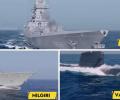
The Indian Navy has commissioned three new warships, INS Surat, INS Nilgiri, and INS Vaghsheer, marking a significant step in India's defense self-reliance and indigenous shipbuilding capabilities. These state-of-the-art vessels are designed and built entirely in India, showcasing the country's growing expertise in defense production. The commissioning of these warships strengthens India's position as a global leader in defense and augments its maritime strength.
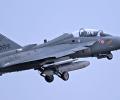
'The Raksha Mantri's day at sea'/

Defence Minister Rajnath Singh launched the Indian Navy's new destroyer warship INS Surat and the Indian Navy's new frigate INS Udaygiri, in Mumbai, May 17, 2022.

The navy's plan to build three Russian Talwar-class frigates has a less than wholesome odour.

The government has cleared the indigenous construction of seven stealth frigates and six nuclear-powered submarines to bolster naval power.
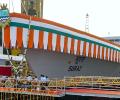
INS Surat is the Indian Navy's first AI enabled warship.

INS Vindhyagiri was launched by President Droupadi Murmu, the Supreme Commander of India's armed forces, in Kolkata on Thursday, August 17, 2023.
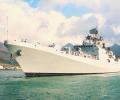
The BrahMos systems for the two ships are estimated to cost Rs 25 billion, making it the world's most expensive anti-ship missile.

These next generation ships can patrol the oceans for three or four months compared to the navy's current patrol boats, which can be at sea for a maximum of 45 days.

India's largest warship builders -- Mazagon Dock Ltd, Mumbai; and Garden Reach Shipbuilders & Engineers, Kolkata - have prevailed over the Indian Navy's objections. MDL and GRSE will divide between them the entire order for seven improved stealth frigates, code-named Project 17A.The Navy was insisting that the first two frigates of Project 17A be built abroad, so that MDL and GRSE could learn how to build ships using new modular methods that are preferred by European shipyard

The Indian Navy is constrained by its lowest budgetary allocation since 2011-2012, reveals Ajai Shukla.

China has been commissioning three new destroyers every year while India has barely completed one destroyer every 2-3 years.

Russia -- already India's biggest arms supplier from 2014-18, accounting for 58 per cent of India's defence imports -- eyes more, reports Ajai Shukla.

Without advanced towed array sonar systems, all warships the navy has built and bought since the 1990s would be sitting ducks in war.

This firing is a significant step towards achieving self-reliance in niche missile technology. Navy said.

INS Khanderi, the second Scorpene-class submarine that can attack with torpedoes as well as tube-launched anti-ship missiles whilst underwater or on surface, was launched at the Mazgaon Dock Shipbuilders Ltd in Mumbai in January 2017.

The ban on import of 101 items is a big step towards an Atma Nirbhar Bharat (self-reliant India). This list of negative items contains not only small items but weapon systems of high and critical technology. More such items will be added to this list shortly which will save crores of rupees in imports, the defence minister said.
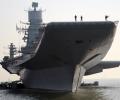
The navy wants to spend Rs 40,000 crore on INS Vishal, a choice the army and air force oppose. This is as much about turf as about funding. explains Ajai Shukla.

Rather than going through the tedious, hit-or-miss process of physically designing hull forms and superstructures for warships and then determining how visible they are to radar, the company will simulate this process on supercomputers.

The tearing hurry to form theatre commands has to be replaced by a balanced and deliberate approach. We need to accept that this process will take time if executed correctly and in the best interests of the Indian armed forces, argues Commodore Venugopal Menon (retd).

The state-of-the-art features of this Scorpene class submarine include superior stealth and the ability to launch a crippling attack on the enemy using precision guided weapon.
